Nature intelligence for better R&D decisions
A signal for science-led investment
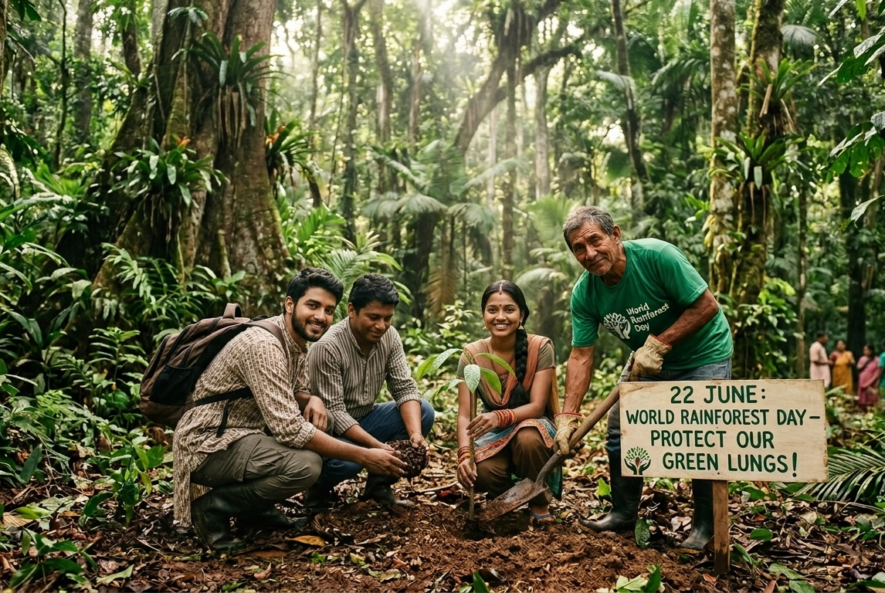
Observed on June 22, World Rainforest Day gives R&D leaders a practical reminder: forests are no longer only a conservation concern. They are part of research planning, supply-chain assurance, regulatory exposure, biodiversity discovery, and IP strategy. The official initiative was founded by Rainforest Partnership in 2017 and is framed as a global call to protect and restore standing rainforests [1]. For innovation teams, the business question is sharper than awareness. Which data can be trusted? Which materials or biological resources are legally usable? Which inventions are patentable? Which markets now expect proof of deforestation-free sourcing before products can move?
Tropical forests carry a disproportionate share of biological value. A peer-reviewed study found that tropical forests harbor 62% of global terrestrial vertebrate species, more than any other terrestrial biome [2]. FAO estimates that 420 million hectares of forest have been lost to deforestation since 1990, with annual deforestation at about 10 million hectares during 2015-2020 [3]. WRI’s 2026 update reported that tropical primary rainforest loss fell 36% in 2025 from the 2024 record, but still reached 4.3 million hectares [4].
From observation to decision-grade evidence
For research organizations, the next stage is not more scattered data. It is better curation. Remote sensing, field studies, specimen records, regulatory documents, local knowledge, supply-chain declarations, and patent literature all describe the same system from different angles. Without Data Management, Data Analytics, and indexing discipline, they remain disconnected.
Global Forest Watch illustrates the direction of travel. Its platform gives access to more than 65 global and local datasets and weekly GLAD deforestation alerts for the tropics [5]. GBIF performs a related function for biodiversity: it is a government-funded international data infrastructure that provides open access to data about life on Earth [7]. These platforms do not replace expert review. They raise the standard for evidence assembly.
A useful analogy is a research library with rare books but no catalogue. The assets may be priceless, but decision makers cannot use them until titles, provenance, dates, locations, and restrictions are indexed in a form that can be searched, checked, and cited.
When policy turns evidence into operating risk
The regulatory direction is clear. The EU Deforestation Regulation applies to cattle, cocoa, coffee, palm oil, rubber, soy, wood, and selected derived products. EU guidance states that, from 30 December 2026, covered products placed on, sold within, or exported from the EU must be deforestation-free and produced in line with relevant laws in the country of production [6]. Non-EU suppliers may still need to provide location and production information so EU companies can meet their obligations [6].
That changes the role of data teams. A sustainability claim is no longer enough. Regulatory strategy now depends on geolocation evidence, traceability records, risk assessment, documentation retention, and audit-ready workflows. Artificial Intelligence can help classify satellite signals, cluster supplier risk, extract obligations from regulations, and detect anomalies, but AI outputs still need human validation. The compliance file must survive legal scrutiny, not just look convincing on a dashboard.
Case module: evidence, enforcement and limits
WRI’s 2026 analysis provides a useful case signal. The 2025 decline in tropical primary rainforest loss was driven largely by Brazil, where non-fire primary forest loss fell 41% compared with 2024 and reached its lowest level on record [4]. WRI linked the decline to stronger environmental policy and enforcement, including the relaunch of Brazil’s PPCDAm anti-deforestation plan and higher penalties for environmental crimes [4].
The contrarian lesson is that a one-year improvement is not proof of durable recovery. WRI also warned that 2025 loss remained 46% higher than a decade earlier and that climate-driven fires are becoming a larger threat [4]. For executives, this means forest data should not be treated as an annual communications input. It should be a monitored risk layer in R&D, sourcing, market-access, and IP planning.
The IP layer in biodiversity-based innovation
Rainforest-linked discovery can move from ecology into pharmaceuticals, cosmetics, crop protection, materials, enzymes, and specialty chemicals. That route creates value, but it also creates obligations. The Nagoya Protocol aims to share benefits from the use of genetic resources fairly and equitably and to improve legal certainty and transparency for providers and users [8]. It also recognizes technology transfer and cooperation as part of building research and innovation capacity [8].
The patent system is also changing. The WIPO Treaty on Intellectual Property, Genetic Resources and Associated Traditional Knowledge, adopted on 24 May 2024, creates a mandatory patent disclosure requirement when claimed inventions are based on genetic resources or associated traditional knowledge [9]. This does not remove the need for standard patentability analysis. It raises the importance of provenance, prior art search, freedom-to-operate, disclosure checks, and careful patent drafting and filing.
For R&D teams, the practical workflow should start before laboratory scale-up: document source material, confirm access rights, map traditional knowledge exposure, run prior art and non-patent literature searches, evaluate patentability, assess FTO, and align filing strategy with regulatory and benefit-sharing obligations. IP protection is strongest when the science record, data record, and legal record tell the same story.
How Saturo Global supports the workflow
Saturo Global supports research, data, and IP teams that need structured evidence for complex innovation decisions. Our work connects Data Curation & Management, Indexing & Abstracting, Strategic Patent Support, PatBase, Origin, Chemical Explorer, and Data Visualization so teams can move from fragmented information to reviewable intelligence.
For rainforest-linked and biodiversity-adjacent innovation, that support can include prior art search, freedom-to-operate support, patent landscape support, patent drafting and filing support, and IP protection strategy. The aim is to help researchers, R&D leaders, technology transfer teams, and IP managers make decisions with documented evidence, not assumptions.
Schedule a demo for a walkthrough of Minesoft PatBase and Origin.
References
[1] Rainforest Partnership. 2026. World Rainforest Day. Rainforest Partnership. Link.
[2] Pillay, R., Venter, M., Aragon-Osejo, J., González-del-Pliego, P., Hansen, A. J., Watson, J. E. M., and Venter, O. 2022. Tropical forests are home to over half of the world’s vertebrate species. Frontiers in Ecology and the Environment. DOI: 10.1002/fee.2420.
[3] Food and Agriculture Organization of the United Nations. 2020. Global Forest Resources Assessment 2020. FAO. Link.
[4] World Resources Institute. 2026. Tropical Rainforest Loss Drops 36% in 2025, but Fires Threaten Global Progress. WRI. Link.
[5] Global Forest Watch. 2026. Forest Monitoring, Land Use & Deforestation Trends. Global Forest Watch. Link.
[6] European Commission. 2026. Implementing the EU Deforestation Regulation and Regulation on Deforestation-free Products. European Commission. Link.
[7] Global Biodiversity Information Facility. 2026. What is GBIF? GBIF. Link.
[8] Secretariat of the Convention on Biological Diversity. 2011. Nagoya Protocol on Access to Genetic Resources and the Fair and Equitable Sharing of Benefits Arising from their Utilization. CBD. Link.
[9] World Intellectual Property Organization. 2024. WIPO Treaty on Intellectual Property, Genetic Resources and Associated Traditional Knowledge. WIPO. Link.
[10] Food and Agriculture Organization of the United Nations and FILAC. 2021. Forest governance by indigenous and tribal peoples. FAO. Link.
[11] National Oceanic and Atmospheric Administration. 2024. How much oxygen comes from the ocean? NOAA Ocean Service. Link.
[12] National Geographic. 2019, updated 2025. Why the Amazon does not really produce 20% of the world’s oxygen. National Geographic. Link.