
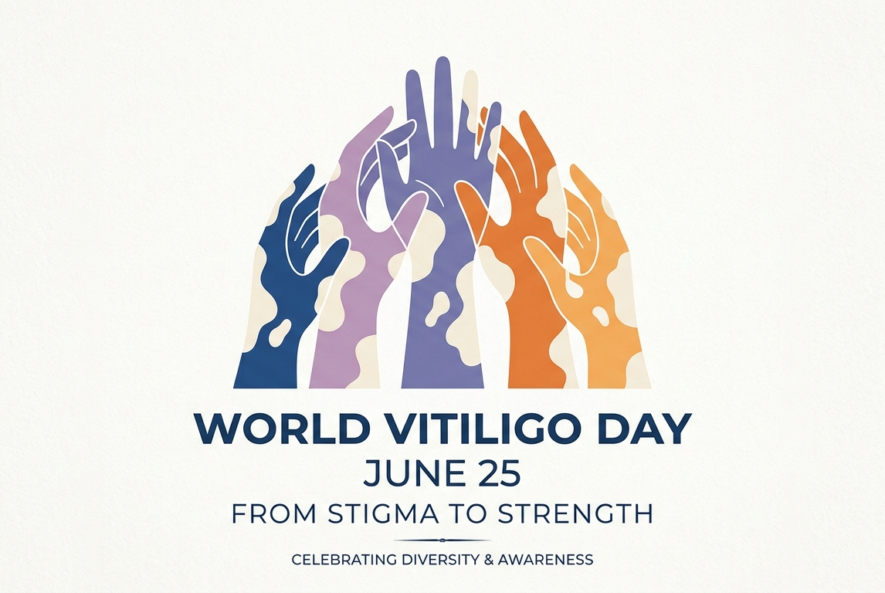
World Vitiligo Day 2026 and the work behind awareness
World Vitiligo Day 2026 is being observed on June 25, with the global headquarters in Chandigarh, India, from June 25 to 28. The verified theme is “From Stigma to Strength” [1]. For R&D leaders, the date should be more than a public awareness marker. It is a reminder that visible disease burden, patient experience, clinical endpoints, data quality, regulatory strategy, and IP protection have to be planned together.
Vitiligo is a long-lasting autoimmune disorder in which melanocytes, the cells that make pigment, are attacked and destroyed [2]. It is not a cosmetic preference problem. It is a skin condition with medical, social, and psychological dimensions. The Global VALIANT study reported that 3,541 patients across 17 countries experienced substantial quality-of-life, emotional, daily-life, and psychosocial burden, with greater burden among people with darker skin types, facial or hand involvement, or more than 5% affected body surface area [3].
From stigma to measurable evidence
Awareness campaigns help dispel myths. R&D systems decide whether that awareness becomes better care. A vitiligo program today may include discovery research on immune pathways, clinical evaluation of repigmentation, patient-reported outcomes, imaging, Data Analytics, and Artificial Intelligence tools that track lesion change over time.
The professional analogy is a clinical pipeline as a supply chain. If the raw materials are poorly labelled, unevenly sourced, or hard to trace, the final product is unreliable. In vitiligo, the raw materials include images, skin-tone metadata, treatment exposure, lesion location, body surface area, quality-of-life measures, adverse events, and patent literature.
Data curation is therefore not back-office administration. It is a scientific control point. Data Management should record what was collected, how it was labelled, who reviewed it, which version was used, and whether the dataset represents the people the product is meant to serve.
A verified case module: ruxolitinib cream
The clearest recent case is topical ruxolitinib. In July 2022, the FDA approved Opzelura, ruxolitinib cream, for nonsegmental vitiligo in adult and pediatric patients 12 years of age and older [4]. In the EU, EMA lists Opzelura for non-segmental vitiligo with facial involvement in adults and adolescents from 12 years of age [5]. EMA also reports that two main studies involving 661 patients showed improved repigmentation compared with placebo, using facial and total-body vitiligo scoring endpoints [5].
This case shows how discovery, clinical evidence, regulatory review, and commercialization meet. The science moved through an immune pathway. The data had to support measurable repigmentation. The regulatory file had to define the population, use, risks, and benefits. The commercial pathway needed patents, market access planning, and clinician adoption. None of those steps can be treated as separate workstreams at the end.
The contrarian insight: AI is not automatically inclusive
AI is often presented as the shortcut to better dermatology workflows. The evidence calls for caution. A dermatology AI study using the Diverse Dermatology Images dataset found that many models had not been rigorously assessed on diverse skin tones or uncommon diseases, and that performance disparities existed on more diverse clinical images [6]. This matters for vitiligo because the condition is visual, often measured through images, and socially experienced differently across skin tones.
The practical lesson is not to avoid AI. It is to build AI with disciplined Data Curation & Management, skin-tone transparency, external validation, audit trails, and clinically meaningful endpoints. FDA guidance on AI-enabled device software functions also points toward planned modification control, validation methods, and assessment of the impact of algorithm changes [7]. For innovators, that means AI strategy and regulatory strategy should be designed at the same table.
Where IP strategy enters the vitiligo pipeline
Patentability and Freedom-to-operate cannot wait until a product is nearly ready for launch. A Prior art search can reveal whether a formulation, biomarker, imaging method, dosing schedule, delivery system, algorithmic workflow, or combination therapy is already disclosed. USPTO materials define prior art broadly as publicly available information before the effective filing date, including patents, published applications, scientific papers, conference proceedings, websites, and other public materials [8]. WIPO’s PATENTSCOPE gives access to international PCT applications, patent documents from national and regional offices, and non-patent literature [9].
For vitiligo R&D teams, patent drafting and filing should reflect the real invention, not just the desired product label. Claims may need to distinguish composition, method of use, image analysis workflow, patient stratification, or manufacturing process. IP protection also needs freedom-to-operate support, competitor monitoring, and patent landscape support so that licensing, Technology Transfer, and commercialization decisions are based on evidence rather than assumptions.
| R&D decision | Data and IP question |
|---|---|
| New mechanism or formulation | Is it novel, non-obvious, and supported by prior art search? |
| AI-assisted imaging | Is the dataset curated, diverse, validated, and regulator-ready? |
| Clinical endpoint strategy | Does the evidence connect repigmentation, safety, and patient burden? |
| University or hospital innovation | Is Technology Transfer supported by ownership, filing, and licensing readiness? |
| Market entry | Is Freedom-to-operate mapped across target jurisdictions? |
How Saturo Global supports research, data, and IP workflows
Saturo Global supports teams that need evidence-ready workflows across research, data, and intellectual property. That includes Data Curation & Management, Indexing & Abstracting, Strategic Patent Support, PatBase, Origin, Chemical Explorer, and Data Visualization.
For vitiligo and other dermatology innovation programs, Saturo Global can support prior art search, freedom-to-operate support, patent landscape support, patent drafting and filing support, and IP protection strategy. The goal is to make research, clinical data, patent intelligence, and commercialization planning work as one operating system.
Schedule a demo for a walkthrough of Minesoft PatBase and Origin.
References
[1] Vitiligo Research Foundation. 2026. World Vitiligo Day 2026 returns to Chandigarh, India. Source: VRF event page. Link. (Vitiligo Research Foundation)
[2] National Institute of Arthritis and Musculoskeletal and Skin Diseases. 2022. Vitiligo Symptoms, Risk Factors, & Causes. Source: NIAMS. Link. (NIAMS)
[3] Bibeau K, Ezzedine K, Harris JE, et al. 2023. Mental Health and Psychosocial Quality-of-Life Burden Among Patients With Vitiligo: Findings From the Global VALIANT Study. JAMA Dermatology. DOI: 10.1001/jamadermatol.2023.2787. (JAMA Network)
[4] U.S. Food and Drug Administration. 2022. FDA approves topical treatment addressing repigmentation in vitiligo in patients aged 12 and older. Source: FDA. Link. (U.S. Food and Drug Administration)
[5] European Medicines Agency. 2026. Opzelura: EPAR medicine overview and product details. Source: EMA. Link. (European Medicines Agency (EMA))
[6] Daneshjou R, Vodrahalli K, Liang W, et al. 2022. Disparities in dermatology AI performance on a diverse, curated clinical image set. Source: PubMed record. Link. (PubMed)
[7] U.S. Food and Drug Administration. 2025. Marketing Submission Recommendations for a Predetermined Change Control Plan for Artificial Intelligence-Enabled Device Software Functions. Source: FDA guidance. Link. (U.S. Food and Drug Administration)
[8] U.S. Patent and Trademark Office. 2021. Patent Searching and Search Resources, An Introduction. Source: USPTO. Link. (USPTO)
[9] World Intellectual Property Organization. 2026. PATENTSCOPE. Source: WIPO. Link. (WIPO)
[10] Vitiligo Research Foundation. 2026. World Vitiligo Day, A Brief History. Source: VRF. Link. (Vitiligo Research Foundation)