A granted patent still needs a commercial evidence case
The grant of a patent settles one question: a patent office has accepted the claimed invention under the applicable examination process. It does not establish market demand, regulatory feasibility, freedom to operate or licensing readiness.
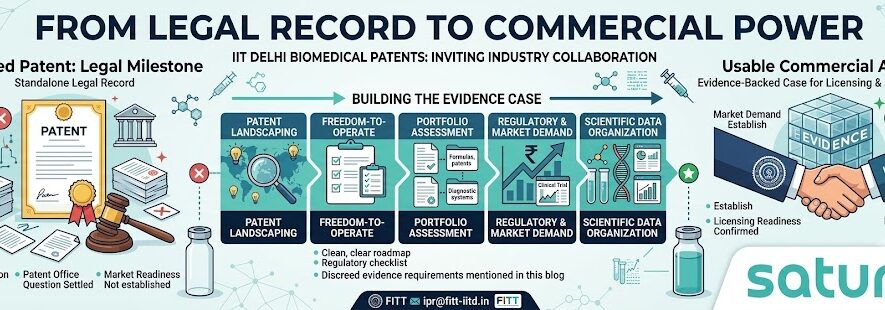
That distinction is relevant to IIT Delhi’s announcement of patents granted in Biomedical & Healthcare Technologies between January and March 2026. Through the Foundation for Innovation and Technology Transfer, IIT Delhi invited industrial partners to explore licensing and further development of the inventions [1].
For research and technology-transfer teams, the next work concerns evidence. R&D investment, partner selection, Data Management, regulatory planning and IP protection depend on whether each patented technology can be assessed as a usable commercial asset rather than a standalone legal record.
Grant is one milestone in a longer review
FITT is IIT Delhi’s technology-transfer arm. It manages the institute’s intellectual-property operations, receives invention disclosures, conducts analysis and due diligence, coordinates formal IP registration and oversees work outsourced to patent law firms [2]. FITT also manages the licensing and transfer of IIT Delhi IP assets and know-how [3].
This is an established commercialization function. A generic offer to administer filings would therefore duplicate work already handled through FITT and its professional advisers.
The stronger proposition concerns the evidence surrounding each asset: patent landscapes, portfolio assessment, India-specific patent intelligence, scientific-data organisation and structured material for partner discussions.
| Commercialization question | Evidence required |
|---|---|
| Does the patent address a defined technical need? | Scientific literature, clinical context and competing approaches |
| How distinct is the invention? | Prior art, patent families and claim comparison |
| Which companies may have a strategic fit? | Applicant activity, portfolios and product pipelines |
| Can a partner develop and sell it? | Freedom-to-operate and regulatory-pathway review |
| What should FITT prioritize? | Technical maturity, protection, market fit and development risk |
The contrarian point is that a granted patent may require more commercial diligence than a newly disclosed invention. Filing and prosecution have already consumed time and resources. The institution must now decide whether further investment in validation, market engagement or international protection is justified.
WIPO describes technology transfer as a process in which technology-transfer offices assess commercial potential, secure IP rights, develop and de-risk inventions, and prepare them for licensees or investors [4]. It also identifies technical advantage, market applicability and freedom of operation as parts of IP evaluation [5].
Build the portfolio view before approaching industry
A biomedical portfolio may include diagnostic systems, medical devices, formulations, biomaterials, algorithms or laboratory methods. Counting patents does not show whether several assets address the same clinical problem, depend on related background IP or compete for the same industry partners.
Data Curation can standardise diseases, intended uses, biological targets, materials, device functions and inventor terminology. Data Management should preserve patent-family links, legal status, prosecution records, supporting experiments, disclosure dates and reviewer decisions.
Indexing & Abstracting can connect each patent with relevant scientific literature, technical reports and regulatory material. Data Analytics can then group technologies by therapeutic area, maturity, claim type, assignee activity or potential application.
Artificial Intelligence may assist semantic search, document classification and technology clustering. It should not determine claim scope, inventorship, Patentability or Freedom-to-operate. Those conclusions require scientific and legal review.
Patent analytics can support R&D planning, IP commercialization and Technology Transfer, according to WIPO [6]. For FITT, this could mean comparing the biomedical patents with global patent families, identifying crowded technical areas and locating fields of use that may offer more room for licensing.
Industry collaboration is publicly invited
The January-to-March announcement is a direct commercialization signal. IIT Delhi stated that it was inviting industrial partners to license the biomedical and healthcare inventions and help advance them towards market-ready applications [1].
The announcement does not publish a complete text list of the patents, their licensing terms, regulatory status, development maturity or partner requirements. It therefore verifies a live technology-transfer pipeline, but it does not establish an external-vendor requirement or indicate that any particular invention is commercially ready.
Where specialist support can add capacity
Saturo Global’s Strategic Patent Support includes Patentability and Prior art search, Freedom-to-operate searches, validity and invalidity research, patent landscaping, claim mapping, portfolio analysis, patent drafting and filing support, and IP protection strategy [8].
Its Indian Patent Database provides historical Indian patent records from 1912 onward. Saturo positions the database for patent landscaping, legal research, FTO, invalidation work, competitor monitoring and innovation scouting [9]. For an Indian academic portfolio, this can complement global patent-family research with records and legal information specific to the domestic system.
Data Curation & Management and Indexing & Abstracting can organise the scientific evidence associated with each invention. Data Visualization can produce portfolio views for licensing teams, research leadership and prospective partners.
PatBase can support patent-family searching, legal-status review and portfolio analysis. Origin provides AI-assisted patent discovery and classification. Chemical Explorer can support chemistry-focused searching within patent documents [10][11][12].
These services should supplement FITT’s institutional authority and patent counsel rather than replace them. The practical objective is a better evidence package for prioritization, licensing and commercialization decisions.
Schedule a demo for a walkthrough of Minesoft PatBase and Origin.
References
[1] Foundation for Innovation and Technology Transfer, IIT Delhi. 2026. IIT Delhi Patents in Biomedical & Healthcare Technologies. LinkedIn.
[2] Foundation for Innovation and Technology Transfer, IIT Delhi. n.d. Intellectual Property Management. FITT.
[3] Foundation for Innovation and Technology Transfer, IIT Delhi. n.d. Technology Transfer & Licensing. FITT.
[4] World Intellectual Property Organization. n.d. Knowledge and Technology Transfer. WIPO.
[5] World Intellectual Property Organization. n.d. Transferring Technology from Lab to Market. WIPO.
[6] World Intellectual Property Organization. n.d. Patent Analytics. WIPO.
[7] Foundation for Innovation and Technology Transfer, IIT Delhi. n.d. FITT Team. FITT.
[8] Saturo Global. n.d. Strategic Patent Support. Saturo Global.
[9] Saturo Global. n.d. Indian Patent Database. Saturo Global.
[10] Minesoft. n.d. PatBase: Patent Search and Analysis Technology. Minesoft.
[11] Minesoft. n.d. Minesoft Origin: AI Patent Search. Minesoft.
[12] Minesoft. 2015. Chemical Explorer for Patent Full-Text Chemical Structure Searching. Minesoft.