When editorial capacity becomes a data problem
In July 2026, Wiley and Springer Nature were recruiting for several editorial positions in India. Wiley’s openings included editorial and assistant-editor roles in Noida and Pune. Springer Nature advertised roles in Pune and New Delhi across oncology, structural biology, biochemistry, biophysics, computer science and other research areas [1–5].
A recruitment cluster does not prove that manuscript submissions are rising, nor does it confirm an intention to outsource work. It does show where operational attention is being directed: manuscript assessment, peer-review coordination, author communication and publication management.
This matters beyond the publishing department. Researchers, R&D managers, regulatory teams and IP professionals depend on journal content that can be found, compared and reused. Editorial judgment determines what is published. Indexing, abstracting and metadata work determine whether that research can be reliably discovered after publication.
The visible role is only part of the workflow
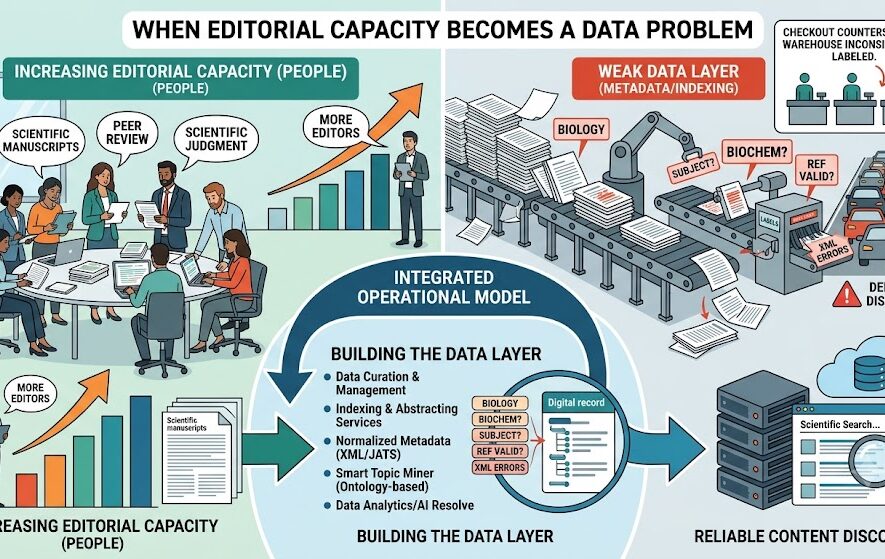
Scientific publishing operates through two connected systems. One applies human judgment to scope, scientific quality, ethics and peer review. The other converts accepted content into structured records that databases, libraries, search tools and research platforms can process.
The second system includes abstract review, subject classification, keyword normalization, author and affiliation checks, reference validation, taxonomy mapping and metadata preparation. These activities may receive less attention than editorial decisions, but weak execution can reduce the value of otherwise sound content.
Adding editors without strengthening this data layer is like adding checkout counters while a warehouse continues to label boxes inconsistently. More people may be available, yet avoidable delays and retrieval errors remain.
Where throughput can stall
The defensible contrarian view is that editorial headcount alone does not guarantee better discoverability.
Crossref maintains infrastructure that connects research objects, contributors, institutions and related records through exchanged metadata [6]. The Journal Article Tag Suite, or JATS, provides a standardized XML structure for journal articles. NISO states that normalized article structures support exchange among publishers, conversion vendors, archives and indexing services [7].
The National Library of Medicine also treats abstract quality and editorial process quality as substantive considerations when assessing journals for MEDLINE. Its review asks whether an abstract accurately describes an article and whether editorial policies, ethical requirements and reporting practices are consistently applied [8].
Indexing and abstracting are therefore part of publishing quality control. They are not decorative tasks added after publication.
A verified case from Springer Nature
A Springer Nature workflow study offers a useful example. Salatino and colleagues described Smart Topic Miner, an ontology-based system developed to assist editors with subject annotation for computer-science conference proceedings [9].
The system was used by editorial teams in India and several other countries, covering about 800 volumes each year. The authors reported faster annotation and better content discovery, including 9.3 million additional downloads associated with the improved topic records.
This result should be treated as a specific case rather than a universal performance benchmark. Its practical lesson is more modest: structured subject annotation, supported by expert review, can improve both editorial efficiency and access to published research.
Building the data layer around editorial teams
A scalable operating model reserves editorial expertise for decisions that require scientific judgment. Managed content teams can then support the repeatable data work surrounding those decisions.
Indexing and abstracting services may cover controlled-vocabulary assignment, abstract quality review, subject classification, reference checks, metadata completion and preparation for XML or JATS workflows. Data Curation keeps terminology, author names and institutional records consistent. Data Management establishes provenance, version control and review rules.
Data Analytics can reveal incomplete fields, correction rates, disciplinary workload and processing time. Data Visualization can make these measures usable for editorial managers. Artificial Intelligence may recommend subject terms, detect anomalies or identify missing information, but trained reviewers should approve scientific classifications and resolve ambiguous cases.
For research-intensive organizations, this work has another downstream use. Better structured literature supports technology scouting, Technology Transfer assessment and regulatory evidence reviews. It can also improve the completeness of scientific literature searches used during patentability assessment, Prior art search and Freedom-to-operate work.
Indexing does not replace patent databases, specialist searchers or legal analysis. It reduces avoidable gaps between published science and the systems used to evaluate it.
Reading the India signal carefully
Wiley and Springer Nature should not be treated as identical opportunities. Their current openings cover different subjects and responsibilities. The shared signal is operational complexity across large scientific-content portfolios.
A credible service discussion should therefore focus on subject-specific capacity, metadata quality, abstracting accuracy, workflow integration and measurable quality controls. It should avoid claiming that recruitment automatically creates a procurement need.
The strongest proposition is practical: editorial investment produces more value when structured content capacity grows with it.
How Saturo Global can support the workflow
Saturo Global can support the underlying research-content layer through Data Curation & Management and Indexing & Abstracting Services, with Data Visualization for workflow and quality reporting.
Where publishing content also supports corporate research and IP programs, Strategic Patent Support can extend the workflow into prior art search, freedom-to-operate support, patent landscape support, patent drafting and filing support, and IP protection strategy. PatBase, Origin and Chemical Explorer can support literature, chemical and patent intelligence work while preserving the distinction between editorial metadata, technical analysis and legal conclusions.
The fit is based on the public operating signals and Saturo Global’s stated capabilities. It does not imply an existing relationship, confirmed procurement plan or guaranteed outcome.
Schedule a demo for a walkthrough of Data Curation & Management and Indexing & Abstracting Services.
References
[1] Wiley. 2026. About us. Wiley.
[2] Wiley. 2026. Editorial Assistant, R2600410. Wiley Careers.
[3] Wiley. 2026. Assistant Editor, Dermatology, R2600787. Wiley Careers.
[4] Springer Nature. 2026. Associate or Senior Editor, Nature Progress Oncology, JR106515. Springer Nature Careers.
[5] Springer Nature. 2026. Associate or Senior Editor, Nature Communications: Structural Biology, Biochemistry or Biophysics, JR106487. Springer Nature Careers.
[6] Crossref. 2026. Crossref: Open infrastructure for the scholarly record. Crossref.
[7] Beck, J., and Usdin, B. T. 2013. JATS: A new standard from an old specification. Information Standards Quarterly, 25(1), 19–21.
[8] National Library of Medicine. 2026. Journal selection for MEDLINE. National Library of Medicine.
[9] Salatino, A. A., Osborne, F., Birukou, A., and Motta, E. 2021. Improving editorial workflow and metadata quality at Springer Nature. arXiv.