When the Sky Becomes a Data Problem
The Risk Signal Research Teams Should Not Ignore
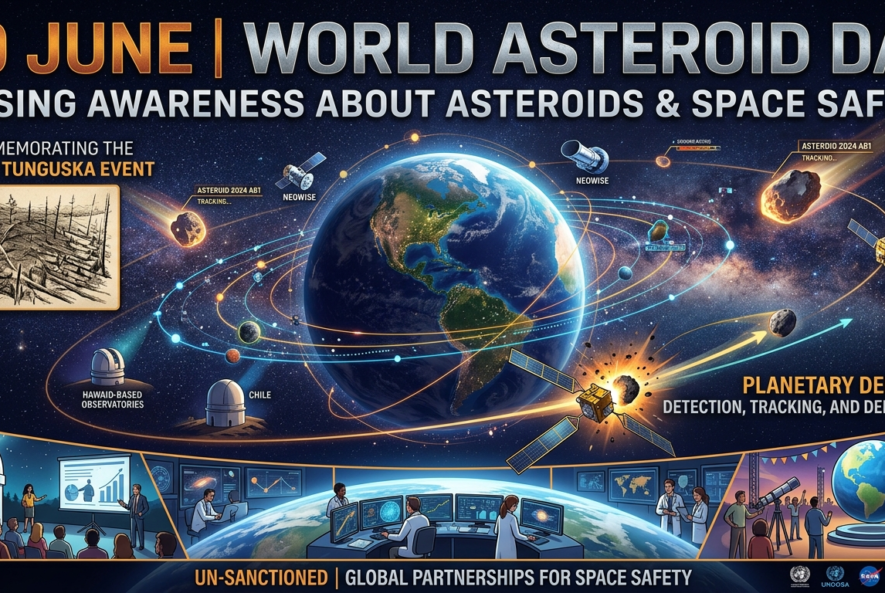
World Asteroid Day, observed on 30 June, is more than a public awareness date. The United Nations frames International Asteroid Day as a way to inform the public about impact hazards and global crisis communication actions if a credible near-Earth object threat is identified [1]. UNOOSA links the date to the 30 June 1908 Tunguska event over Siberia, described as the largest asteroid impact event in recorded history [2].
For R&D leaders, the lesson is practical: rare events still need repeatable systems. Planetary defense depends on discovery, data curation, Data Management, Data Analytics, Artificial Intelligence, mission engineering, Technology Transfer, regulatory strategy, patentability review, Prior art search, Freedom-to-operate analysis, Patent drafting and filing, patents, and IP protection. The same operating logic applies across advanced research portfolios. You cannot commercialize what you cannot characterize.
Discovery Is a Data Supply Chain
Near-Earth object monitoring begins with observation, but observation alone is not enough. NASA’s December 2025 update reported 39,123 discovered near-Earth asteroids, including 11,343 larger than roughly 140 meters, with an estimated 14,000 of that size still left to find [3]. That gap is a reminder that the first innovation bottleneck is often not invention. It is incomplete visibility.
Detection programs depend on telescopes, follow-up observations, orbit calculation, uncertainty modeling, and fast exchange of records. NASA’s CNEOS explains that newly detected objects can appear on risk pages because early observations do not yet define their future paths well enough; many are removed after more observations improve their orbits [4]. In corporate R&D terms, the raw signal must move through a governed pipeline before it becomes a decision.
A useful analogy is air traffic control. A radar return is not a flight plan. It becomes operational intelligence only after identification, validation, routing, and communication. Space safety works the same way.
From Observation to Decision
The 2023 U.S. planetary defense strategy defines the work as the ability to detect and warn about potential impacts and to prevent or mitigate effects where possible [5]. NASA’s companion strategy focuses on detection, tracking, characterization, modeling, prediction, information integration, reconnaissance, deflection, disruption technologies, international cooperation, emergency procedures, and interagency coordination [6].
For innovation teams, this is a useful management template. Discovery without Data Management creates noise. Data Management without analytics creates archives. Data Analytics without governance creates false confidence. Artificial Intelligence can help sort, classify, summarize, and model large technical datasets, but only when the source data and assumptions are traceable.
The Verified Case: DART
NASA’s Double Asteroid Redirection Test, DART, is the clearest verified case module. On 26 September 2022, the DART spacecraft intentionally impacted Dimorphos, the small moonlet of Didymos. NASA later reported that the mission shortened Dimorphos’ orbit by 32 minutes and confirmed kinetic impact as an effective planetary defense technique in that test context [7]. A 2024 NASA study also found that the impact changed both the orbit and shape of Dimorphos [8].
The business lesson is not “build a spacecraft.” It is that high-risk technologies need staged evidence. DART converted a theoretical mitigation approach into measured performance data. That is what strong R&D governance should do for sensors, materials, software models, medical devices, clean technologies, and chemical platforms.
A Contrarian Point: The Hard Part Is Not the Deflection
Popular narratives focus on the dramatic intervention. The harder and earlier work is less cinematic: finding objects, reducing uncertainty, maintaining interoperable data, coordinating agencies, and deciding when information is mature enough for public communication. UNOOSA identifies the International Asteroid Warning Network and the Space Mission Planning Advisory Group as coordination mechanisms created from UN-endorsed recommendations [9].
This matters to R&D and IP strategy. A technically brilliant solution is weak if the team cannot show what is new, what is already disclosed, what is protected, and what can be practiced without infringing third-party rights. Patentability, Prior art search, Freedom-to-operate, Patent drafting and filing, and IP protection are not end-stage legal chores. They are part of the evidence system that lets leaders fund, partner, license, and commercialize with discipline.
| Planetary defense workflow | Innovation and IP workflow |
| Detect and track objects | Identify inventions, publications, standards, and competitor filings |
| Curate observations | Normalize scientific, patent, and regulatory data |
| Model impact probability | Analyze technical relevance, claim overlap, and market entry risk |
| Coordinate response protocols | Align R&D, legal, regulatory, and commercialization teams |
| Test mitigation technology | Validate patentability, FTO, filing strategy, and licensing options |
What This Means for Commercialization
Space safety also shows why Technology Transfer needs structured intelligence. NASA’s Technology Transfer portal makes NASA patents available through a patent licensing program, and NASA states that its patent portfolio includes technologies with commercial potential [10]. WIPO explains that patent landscape reports can inform strategic research planning and technology transfer, and can also use legal status data to support validity analysis [11]. USPTO’s Patent Public Search provides enhanced access to prior art through a web-based patent search application [12].
In practice, teams working on advanced materials, imaging systems, autonomous navigation, propulsion, data platforms, or chemical sensing should connect scientific discovery with IP review early. That means mapping patents and non-patent literature, screening prior art before disclosure, checking FTO before product commitments, drafting claims around defensible novelty, and visualizing the competitive landscape for executives.
Saturo Global as a Workflow Partner
Saturo Global supports research, data, and IP workflows that turn technical uncertainty into usable intelligence. For teams working across space technology, advanced engineering, chemistry, materials, AI-enabled analytics, or commercialization, Saturo Global can assist with Data Curation & Management, Indexing & Abstracting, Strategic Patent Support, PatBase, Origin, Chemical Explorer, and Data Visualization.
That support can help teams structure prior art search, freedom-to-operate support, patent landscape support, patent drafting and filing support, and IP protection strategy. Minesoft describes PatBase as a global patent insights platform and Origin as an AI-enabled patent search and analytics workflow; Chemical Explorer is described as a tool for searching chemical information from patent text and related patent content [13], [14], [15]. The aim is not to replace expert judgment. It is to give R&D, IP, and commercialization leaders a cleaner evidence base before decisions become expensive.
Schedule a demo for a walkthrough of Minesoft PatBase and Origin.
References
[1] United Nations. 2026. International Asteroid Day. United Nations Observances. Link:
[2] United Nations Office for Outer Space Affairs. 2016. United Nations General Assembly proclaims 30 June as International Asteroid Day. UNOOSA. Link:
[3] NASA. 2025. Near-Earth Asteroids as of December 2025. NASA Science. Link:
[4] NASA Jet Propulsion Laboratory, Center for Near Earth Object Studies. n.d. Introduction to Sentry: Earth Impact Monitoring. CNEOS. Link:
[5] National Science and Technology Council. 2023. National Preparedness Strategy and Action Plan for Near-Earth Object Hazards and Planetary Defense. NASA-hosted PDF. Link:
[6] NASA. 2023. NASA Planetary Defense Strategy and Action Plan. NASA. Link:
[7] NASA Jet Propulsion Laboratory. 2026. NASA’s DART Mission Changed Orbit of Asteroid Didymos Around Sun. JPL. Link:
[8] NASA Jet Propulsion Laboratory. 2024. Asteroid’s Orbit, Shape Changed After DART Impact. JPL. Link:
[9] United Nations Office for Outer Space Affairs. 2018. Near-Earth Objects and Planetary Defence. UNOOSA, IAWN, SMPAG. Link:
[10] NASA Technology Transfer Program. n.d. T2 Patent Portfolio. NASA. Link:
[11] World Intellectual Property Organization. n.d. Patent Analytics. WIPO. Link:
[12] United States Patent and Trademark Office. 2026. Patent Public Search. USPTO. Link:
[13] Minesoft. n.d. PatBase: Leading Online Patent Search Database. Minesoft. Link:
[14] Minesoft. n.d. Minesoft Origin: Advanced AI Patent Search. Minesoft. Link:
[15] World Intellectual Property Organization. n.d. ASPI: Specialized Patent Information. WIPO. Link: