From Rainforest Data to Responsible Innovation
Why this region now shapes R&D choices
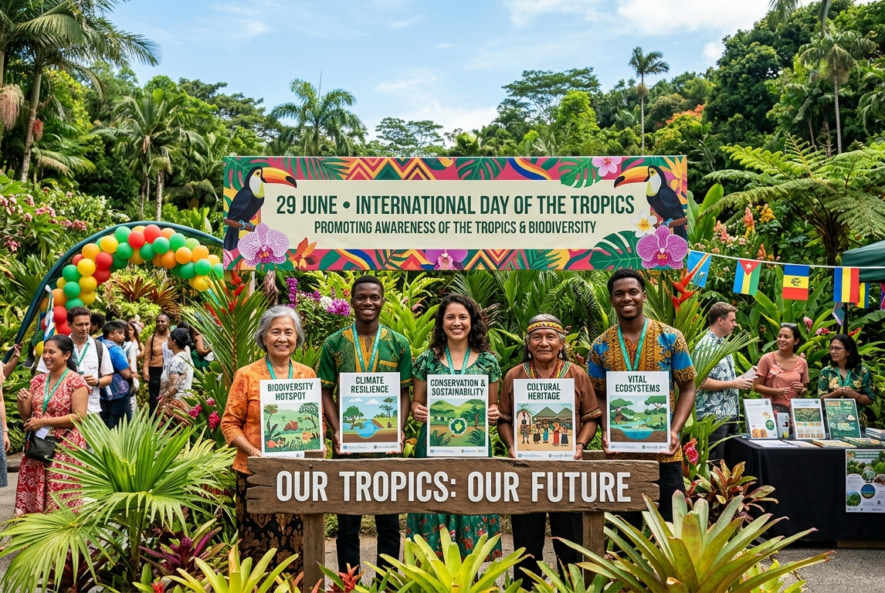
On 29 June, the United Nations marks a day created to raise awareness of tropical regions and the problems and opportunities concentrated there. The date traces back to the first State of the Tropics Report, launched on 29 June 2014, and to a 2016 UN General Assembly resolution designating 29 June as the annual observance [1], [2].
For R&D leaders, this is not a calendar note. Tropical regions cover about 40 percent of the world’s surface and hold about 80 percent of global biodiversity [1]. They also hold most coral and mangrove ecosystems, major forest carbon stores, fast-growing populations, and large gaps in health, water, infrastructure, and research capacity [1], [3]. In practical terms, the region is where discovery, data governance, regulatory strategy, and IP protection increasingly meet.
The evidence chain matters before the invention claim
Tropical biodiversity can feed innovation in crop science, climate adaptation, biomaterials, diagnostics, marine products, pharmaceuticals, water systems, and ecological monitoring. But discovery alone is not enough. Research teams need an evidence chain that connects field observations, samples, sequence data, literature, patents, grants, trial records, standards, and regulatory constraints.
A simple analogy helps: treating tropical innovation without data curation is like running a port without customs records. Goods may move, but ownership, provenance, risk, and value become hard to defend.
The State of the Tropics project noted that R&D expenditure as a share of GDP in the region lagged the rest of the world in earlier benchmark data [3]. That makes Data Management, Data Analytics, and Artificial Intelligence especially important. Clean, indexed, and traceable datasets help teams see which problems are scientifically plausible, which technologies already exist, and which claims can survive review.
Where data, AI, and IP should meet
The Convention on Biological Diversity now treats knowledge management as central to biodiversity action. Target 21 calls for the best available data, information, and knowledge to be accessible for decision makers, while also recognizing consent and rights around traditional knowledge [5]. The Nagoya Protocol adds another layer: access to genetic resources and benefit-sharing must be handled with legal certainty and transparency [6].
That creates a direct operating question for innovation teams: can the organization prove where the biological input, technical insight, and inventive step came from?
AI can help by mining literature, patents, non-patent literature, taxonomies, geospatial data, and regulatory documents. WIPO’s technology trend work shows why patent and scientific data are useful for understanding innovation activity [7]. WIPO GREEN also shows how technology exchange can connect climate technology needs and solutions [7]. Still, AI output must be governed. It should support, not replace, expert review of patentability, enablement, inventorship, prior art, and freedom-to-operate.
| Workflow decision | Why it matters |
| Discovery and data curation | Links samples, species, methods, locations, and rights before claims are drafted |
| Prior art search | Tests novelty and inventive step across patents and scientific publications |
| Freedom-to-operate | Identifies blocking patents, territorial risk, and licensing needs |
| Patent drafting and filing | Converts validated technical contribution into defensible claims |
Case module: fire data changes the investment question
Forest intelligence is a useful case. IPCC assessed that more than 420 million hectares of forest were lost globally from 1990 to 2020, with more than 90 percent of that deforestation occurring in tropical areas [4]. Global Forest Watch later reported that tropical primary rainforest loss reached 6.7 million hectares in 2024, driven largely by fires, and that 2025 loss fell by 36 percent from that record year while fire remained a growing threat [8].
For investors and R&D managers, the lesson is not only that forests are at risk. The lesson is that monitoring technology, satellite analytics, fire prediction, restoration methods, seed systems, carbon measurement, and community-based land tools need patent landscaping, data validation, regulatory planning, and commercialization pathways. The best environmental technology may fail if it cannot cross the IP, procurement, standards, and field-adoption gap.
A useful contrarian view
More open data will not automatically protect biodiversity. Poorly governed openness can expose traditional knowledge, weaken benefit-sharing positions, or create prior art problems before an invention is ready for patent drafting and filing. CBD knowledge guidance and the Nagoya Protocol point to a more careful model: make data useful, but keep provenance, permissions, access terms, and downstream use visible [5], [6].
For companies, universities, and technology transfer teams, this changes the question from “What can we extract?” to “What can we validate, protect, license, and return responsibly?” That is where regulatory strategy, IP protection, and commercialization discipline belong at the start of the project.
How Saturo Global supports the workflow
Saturo Global supports research, data, and IP teams working at the point where tropical science becomes usable innovation. Our work spans Data Curation & Management, Indexing & Abstracting, Strategic Patent Support, PatBase, Origin, Chemical Explorer, and Data Visualization.
For R&D and IP teams, that means structured support for prior art search, freedom-to-operate support, patent landscape support, patent drafting and filing support, and IP protection strategy. PatBase and Origin can help teams search, organize, analyze, and visualize patent intelligence across technology areas, while Chemical Explorer supports chemical patent review where compound-level evidence matters [9]. Combined with disciplined data workflows, these tools help teams move from scattered evidence to clearer decisions.
The tropics should not be treated as a remote research theme. They are a test of whether innovation systems can respect biodiversity, strengthen local value, reduce technical uncertainty, and protect genuine invention.
Schedule a demo for a walkthrough of Minesoft PatBase and Origin.
References
[1] United Nations. 2025. International Day of the Tropics. UN Observances. Link.
[2] United Nations General Assembly. 2016. Resolution A/RES/70/267. United Nations Digital Library. Link.
[3] State of the Tropics. 2014. State of the Tropics Project. James Cook University. Link.
[4] IPCC. 2022. Cross-Chapter Paper 7: Tropical Forests. Climate Change 2022: Impacts, Adaptation and Vulnerability. Link.
[5] Secretariat of the Convention on Biological Diversity. 2024. Knowledge Management in the Kunming-Montreal Global Biodiversity Framework. CBD. Link.
[6] Secretariat of the Convention on Biological Diversity. 2014. The Nagoya Protocol on Access and Benefit-sharing. CBD. Link.
[7] World Intellectual Property Organization. 2019-2025. WIPO Technology Trends and WIPO GREEN. WIPO. Link.
[8] World Resources Institute and Global Forest Watch. 2025-2026. Global Forest Review tree cover loss analysis. WRI. Link.
[9] Minesoft. 2026. PatBase, Origin, and ChemX product information. Minesoft. Link.