From Resource Maps to Market-Ready Clean Power
The investment signal is now measurable
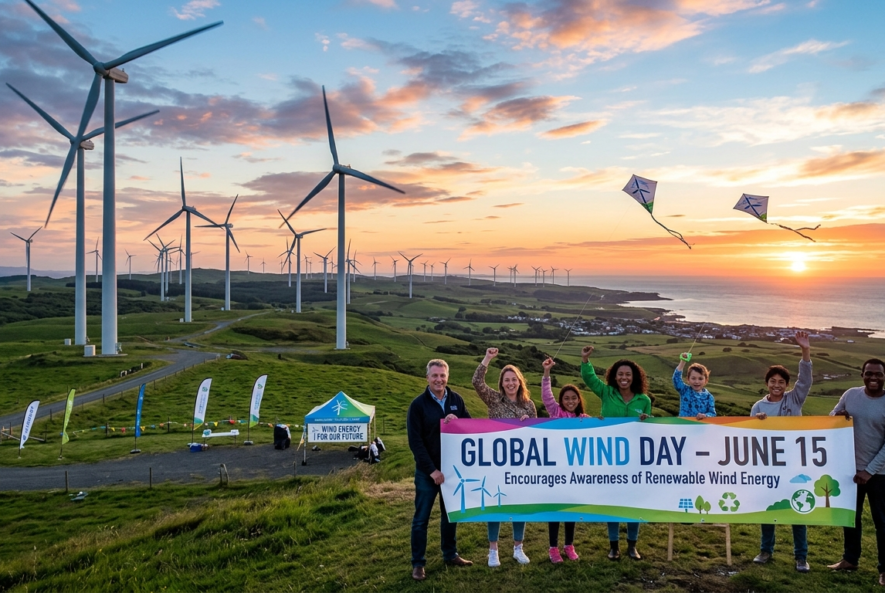
On 15 June, Global Wind Day gives R&D leaders more than a communications moment. It is a useful checkpoint for capital allocation, technology scouting, data workflows, IP strategy, commercialization planning, and regulatory readiness. GWEC and WindEurope describe the day as a global campaign around clean, cost-effective, homegrown power, with the 2026 campaign focused on community-level value [1], [2]. (gwec.net)
The market signal is larger than the occasion. GWEC reported that the wind sector added a record 165 GW of new capacity in 2025, taking global wind power to 1,299 GW across 138 countries [3]. IRENA reported that renewables made up 49% of global installed power capacity by the end of 2025, with 692 GW of renewable additions that year, including 159 GW of wind [4]. (gwec.net)
For enterprises, the message is practical: wind is moving from an energy procurement option to a technology, data, and risk-management system. A wind project is like a clinical trial for infrastructure. The asset succeeds only when evidence, protocols, approvals, and monitoring move together.
India’s buildout is now a data workflow
India has become one of the most important wind markets for that reason. MNRE data show cumulative wind capacity of 56.807 GW as of 31 May 2026 [6]. A PIB backgrounder released on 14 June 2026 states that India ranked fourth globally in installed wind capacity, grew from 21.04 GW in March 2014 to 56.09 GW in March 2026, and recorded its highest annual wind addition of 6.05 GW in 2025-26 [7]. (MNRE)
Case module: India’s 100 GW pathway
The same PIB backgrounder assessed India’s gross wind power potential at 695.5 GW at 120 metres and 1,163.9 GW at 150 metres. It also identified Andhra Pradesh’s 150-metre gross potential at 123.3 GW and stated that India’s resource base supports a path toward 100 GW of wind capacity by 2030 and 156 GW by 2036 [7].
That opportunity is not only about installing turbines. The backgrounder points to more than 900 wind-monitoring stations, resource maps at multiple hub heights, AI-based forecasting tools, grid modernization, storage-linked business models, and domestic manufacturing as priorities [7].
The technical race is wider than turbines
The contrarian insight is simple: record deployment does not remove execution risk. IEA expects onshore wind additions in 2025-2030 to be 45% higher than in 2019-2024, but it also cites supply chain bottlenecks, inflation, permitting, and grid connection waits as continuing constraints [5]. IEA also notes that grid integration, supply chain vulnerability, financial pressure, and policy shifts are becoming larger concerns across renewables [5]. (IEA)
This changes the R&D agenda. Discovery must connect resource science, turbine engineering, materials, digital control, wake modelling, forecasting, storage, power electronics, submarine cables, and grid protection. Data Curation, Data Management, and Data Analytics are now core engineering functions, not back-office activities. Artificial Intelligence can support forecasting and patent review, but poor input data still leads to poor investment decisions.
Patent intelligence adds another layer. The IEA states that patents provide early indications of technologies that may shape the energy transition [8]. EPO and IRENA reviewed roughly 17,000 offshore wind patent families published from 2002 to 2022, covering fixed and floating foundations, towers, mechanical transmission, blades and rotors, hybrid systems, storage, grids, and submarine cables [9]. (IEA)
| Decision area | What teams should check |
| Discovery | Scientific literature, standards, patents, grants, and field data |
| Commercialization | Resource quality, grid access, supplier depth, and offtake structure |
| Regulatory strategy | Permitting, land or seabed rights, RPO rules, grid codes, and local content |
| IP protection | Patentability, prior art search, Freedom-to-operate, Patent drafting and filing, and licensing options |
What R&D and IP teams should do next
Wind innovation needs a tighter bridge between R&D and IP. Before a blade material, offshore foundation, forecasting model, gearbox design, or hybrid-storage configuration enters development, teams should run a Prior art search to test novelty, a patentability review to refine claim scope, and a Freedom-to-operate screen to identify blocking patents. Patent drafting and filing should then translate the engineering difference into defensible claims.
Technology Transfer teams should also treat patent maps as market maps. In offshore wind, EPO and IRENA found invention activity around floating foundations, logistics, mechanical transmission, storage, and hydrogen integration [9]. Those areas point to where licensing, joint development, standards participation, and supplier partnerships may carry commercial value. (irena.org)
How Saturo Global supports execution
Saturo Global supports research, data, and IP workflows where clean-energy strategy depends on evidence quality. The team can assist with Data Curation & Management, Indexing & Abstracting, Strategic Patent Support, patent landscape support, prior art search, freedom-to-operate support, patent drafting and filing support, and IP protection strategy.
For wind, that means helping teams connect technical literature, patent families, regulatory signals, and market evidence into usable decision views. Saturo Global can support workflows using PatBase, Origin, Chemical Explorer, and Data Visualization so R&D, legal, and commercialization teams work from the same evidence base.
Schedule a demo for a walkthrough of Minesoft PatBase and Origin.
References
[1] Global Wind Energy Council. 2026. “Global Wind Day.” GWEC. Link: (gwec.net)
[2] Global Wind Day. 2026. “Global Wind Day 2026.” GWEC and WindEurope campaign site. Link: (Global Wind Day)
[3] Global Wind Energy Council. 2026. “Global Wind Report 2026.” GWEC. Link: (gwec.net)
[4] International Renewable Energy Agency. 2026. “Renewable Capacity Statistics 2026.” IRENA. ISBN 978-92-9260-725-8. Link: (irena.org)
[5] International Energy Agency. 2025. “Renewable Electricity, Renewables 2025.” IEA. Link: (IEA)
[6] Ministry of New and Renewable Energy. 2026. “Programme/Scheme wise Cumulative Physical Progress as on 31st May, 2026.” MNRE. Link: (MNRE)
[7] Press Information Bureau, Government of India. 2026. “Global Wind Day 2026: Charting India’s Path to 100 GW and Beyond.” PIB Backgrounder. Link:
[8] International Energy Agency. 2025. “Energy Technology Patents Data Explorer.” IEA. Link: (IEA)
[9] European Patent Office and International Renewable Energy Agency. 2023. “Offshore Wind Energy: Patent Insight Report.” EPO and IRENA. Link: (irena.org)