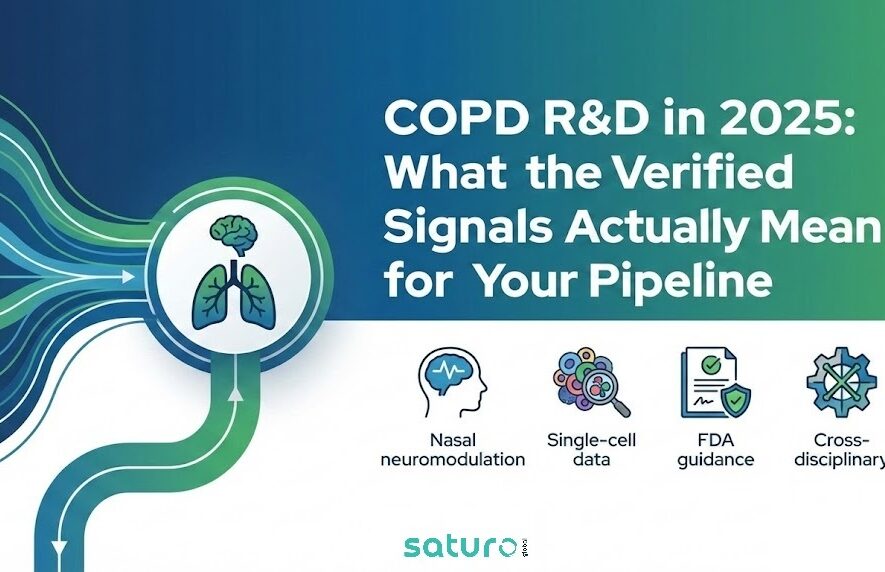
COPD R&D in 2025: What the Verified Signals Actually Mean for Your Pipeline
Contributed by: Haridasu Surya Phani Syloosha
COPD R&D entered 2025 with clear, publicly verifiable shifts: commercial progress in nasal neuromodulation, expanding single-cell COPD datasets, and a regulatory environment increasingly aligned with combination-product development.
Current Trends in COPD R&D
- Nasal neuromodulation is a working, regulated category
Neurent Medical’s NEUROMARK system received FDA 510(k) clearance in 2025 for chronic rhinitis, and the company continues to run clinical studies of intranasal neuromodulation. These systems target posterior nasal neural pathways relevant to sensory and autonomic signaling in the upper airway.
Sources: Neurent 510(k) clearance; MERIDIEN clinical study on ClinicalTrials.gov.
- Single-cell and multi-omic COPD datasets are now standard R&D assets
Multiple publicly available COPD single-cell atlases characterize epithelial, immune, stromal, and neuronal-adjacent populations at high resolution. These datasets are being used in peer-reviewed research to define cell-type signatures, inflammatory pathways, and candidate molecular targets.
Sources: Published single-cell COPD atlases (e.g., Blackburn et al.; related airway single-cell datasets).
- FDA guidance supports structured device–drug planning
The FDA maintains active guidance resources for combination products via the Office of Combination Products, along with 2025 draft guidance documents relevant to device regulation and cross-center review processes. These resources define jurisdiction boundaries, data expectations, and recommended pre-submission planning.
Sources: FDA combination-product resources; 2025 draft guidance publications.
- CSF-directed device platforms exist but remain CNS-focused
Companies such as EnClear Therapies publicly describe device platforms for CSF handling and protein-clearance concepts. While not COPD therapies, they illustrate how device-based biological modulation is being positioned in adjacent fields.
Sources: EnClear public program descriptions.
What This Means for Life Sciences R&D Teams
- Neuromodulation is no longer speculative. The existence of cleared devices and active trials means airway-adjacent neuromodulation is a real, regulated modality—not an exploratory hypothesis. R&D groups should evaluate whether relevant neural-pathway endpoints intersect their respiratory programs.
- Multi-omic COPD data is sufficiently mature for target triage. The availability of multiple single-cell datasets enables reproducible target-ranking, ligand–receptor mapping, and phenotype clustering without waiting for proprietary datasets.
- Combination-product strategies must be designed from day one. The FDA’s established combination-product pathways provide a predictable structure for teams exploring device–drug or biologic–device approaches.
- Adjacent platforms are shaping investor and regulatory expectations. Even if not directly applicable to COPD, the commercial and regulatory patterns from CSF device platforms indicate how cross-disciplinary technologies are evaluated.
How Saturo Global Accelerates Execution
Saturo Global operates as a data-backbone partner for R&D organizations building respiratory, neuromodulation, and multi-omic pipelines. Our services remove friction across the discovery-to-regulatory chain.
We standardize, harmonize, and annotate heterogeneous datasets—clinical trial outputs, registry data, multi-omic studies, and manufacturing or device-performance records—into clean, analysis-ready structures.
Indexing & Abstracting Services
We convert research articles, regulatory documents, and global patents into searchable, structured knowledge layers. This makes literature and patent intelligence retrievable at scale.
We deliver patent landscape mapping, whitespace identification, competitor activity analysis, and support for licensing and technology-transfer decisions. Our approach integrates structured patent metadata with scientific context.
We translate multi-layered scientific, clinical, and technical data into decision-ready visualizations for R&D, BD, and regulatory teams. Dashboards can integrate omics, imaging, device parameters, and IP signals into a unified analytical view.
The Bottom Line
COPD R&D in 2025 is shaped by verifiable developments: cleared neuromodulation devices, publicly available single-cell datasets, and a defined combination-product regulatory pathway. Teams that treat these as operational facts—not speculative trends—will move faster.
Saturo Global provides the data foundation to act on these signals with precision.