The evidence architecture behind faster candidate decisions
A recruitment notice can reveal where scientific capacity is being built. It cannot, by itself, prove that an external supplier is needed. That distinction matters when assessing Sai Life Sciences’ recent search for a DMPK Scientist in Hyderabad.
The role covers in vivo pharmacokinetics, ADME and PK quality control, PK-PD and PBPK modelling, transporter and hepatocyte assays, physicochemical testing, metabolism studies and IND-enabling work [1]. For R&D leaders, these activities affect candidate selection, research investment and regulatory planning. They also produce compound-level evidence that must remain usable across chemistry, biology, toxicology, clinical pharmacology, intellectual property and client reporting workflows.
The signal is capacity, not a purchase order
Sai Life Sciences publicly describes an integrated discovery model that connects medicinal chemistry, biology, DMPK, pharmacology and toxicology. Its DMPK offering includes in vitro ADME, in vivo PK, metabolite identification, drug-interaction assessment and translational modelling [2][3].
The recruitment notice is therefore credible evidence of continuing scientific capability. It is not evidence of a data-curation contract, procurement exercise or systems gap.
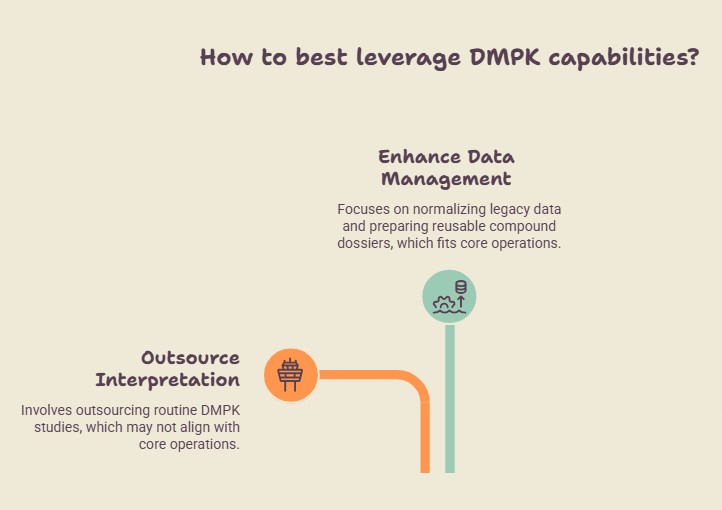
This produces a defensible commercial conclusion. The strongest proposition is unlikely to be outsourced interpretation of routine DMPK studies, since those activities sit within Sai Life Sciences’ stated core operations. A better fit is structured evidence support around high-volume, multi-project research: normalising legacy data, preparing reusable compound dossiers, linking assay results to source context and building comparison datasets for scientific review.
Think of the workflow as an airport control tower. Individual studies are the aircraft, but safe movement depends on consistent identifiers, shared status information and an accurate record of where each result came from.
Where evidence breaks between projects
A CRO may generate solubility, permeability, protein binding, microsomal stability, hepatocyte clearance, transporter, metabolite and in vivo exposure data across separate client programmes. The scientific methods differ, and so do units, species, matrices, dose routes, formulations, time points and analytical platforms.
A number without this context is difficult to compare. A clearance result, for example, cannot be reused responsibly unless the record preserves the experimental system, units, compound form, protocol, calculation method and source.
| Evidence layer | Decision supported |
|---|---|
| Compound identity and structure | Cross-study matching and duplicate control |
| Assay conditions and methods | Interpretation and comparability |
| ADME and PK parameters | Lead optimisation and candidate ranking |
| Dose, route, formulation and species | Translational assessment |
| Source, version and reviewer history | Traceability and quality review |
Data Curation should establish controlled fields, units, taxonomies and validation rules. Data Management should govern identifiers, lineage, access controls and version history. Indexing & Abstracting can make study reports, literature and regulatory documents retrievable at the level of compound, assay and endpoint.
Data Analytics can then compare exposure, clearance, bioavailability and related parameters without hiding methodological differences. Artificial Intelligence may assist document classification, entity extraction and anomaly detection. It should not silently resolve conflicting units, infer missing assay conditions or replace expert review of PK and ADME evidence.
Regulatory use depends on context
The ICH M12 guideline promotes a consistent approach to designing, conducting and interpreting enzyme- and transporter-mediated drug-interaction studies. It covers in vitro evaluation, clinical assessment, pharmacokinetic analysis, reporting, risk management and predictive modelling [4].
That structure has a direct data implication. Regulatory strategy requires more than final summary values. Review teams need to understand how results were generated, how models were parameterised and whether evidence from metabolism, transporters and clinical studies can be connected.
Verified case: the advertised role spans the evidence chain
Sai Life Sciences’ listing asks for experience with Phoenix WinNonlin, PBPK and PK-PD tools, solubility, LogD, plasma protein binding, microsomal and hepatocyte stability, CYP inhibition, permeability assays and IND-enabling studies [1]. Its official DMPK page describes real-time integration of ADME and PK findings with chemistry and biology teams [2].
Together, these sources show a research environment where data must travel between disciplines. They do not establish an external-vendor requirement. Any proposed engagement would need clear confidentiality controls, client-specific segregation, data ownership terms and compatibility with internal systems.
Support the evidence layer without replacing core science
Saturo Global can support this type of operating model through Data Curation & Management and Indexing & Abstracting. Chemistry Data Curation includes chemical-structure standardisation, compound-target-indication mapping and SAR data. Biology Data Curation includes research dossiers, gene and pathway annotation and multi-omics structuring. Its clinical-pharmacology offering includes legacy-data standardisation and pharmacometrics visualisation [5].
The Human PK Database contains structured fields for ADME, AUC, bioavailability, volume of distribution, half-life and clearance, together with study design, population, dose, route, formulation and analytical-method context [6]. Its most credible role for a CRO prospect is external benchmarking and research-support evidence, subject to validation against the intended scientific use. It should not be presented as a substitute for proprietary study data or internal modelling systems.
Data Visualization can convert curated evidence into review dashboards for compound progression, assay completeness and data-quality exceptions. Strategic Patent Support can connect selected programmes with patentability and Prior art search, Freedom-to-operate support, patent landscape support, patent drafting and filing support, patents and wider IP protection strategy [7].
PatBase and Origin can support patent discovery, portfolio review and competitive analysis. Chemical Explorer can retrieve chemical disclosures from patent documents through structure and terminology searches [8][9][10]. These tools may also support Technology Transfer or commercialization reviews where compound differentiation, ownership and third-party rights must be assessed separately from scientific performance.
Schedule a demo for a walkthrough of Minesoft PatBase and Origin.
References
[1] Sai Life Sciences Ltd. 2026. Hiring for DMPK Scientist. LinkedIn Jobs.
[2] Sai Life Sciences. n.d. DMPK Services: ADME & Pharmacokinetics. Sai Life Sciences.
[3] Sai Life Sciences. n.d. Integrated Drug Discovery Services. Sai Life Sciences.
[4] International Council for Harmonisation. 2024. Drug Interaction Studies M12. ICH Harmonised Guideline.
[5] Saturo Global. n.d. Scientific Data Curation Services. Saturo Global.
[6] Saturo Global. n.d. Human PK Database. Saturo Global.
[7] Saturo Global. n.d. Strategic Patent Support. Saturo Global.
[8] Minesoft. n.d. PatBase: Leading Patent Search and Analysis Technology. Minesoft.
[9] Minesoft. n.d. Minesoft Origin: Advanced AI Patent Search. Minesoft.
[10] Minesoft. 2015. Minesoft Launches Chemical Explorer for Patent Full-Text Chemical Structure Searching. Minesoft.