
Deworming: Evidence Standards, Scalable Delivery, and R&D Implications
Executive Summary
National Deworming Day is a Government of India program, launched in 2015, that provides fixed-day, school- and Anganwadi-based deworming for children and adolescents aged 1 to 19 years, conducted in two rounds each year on 10 February and 10 August. The National Health Mission estimates that around 22 crore Indian children aged 1 to 14 are at risk of soil-transmitted helminth (STH) infections, and the World Health Organization estimates that STH infections affect approximately 1.5 billion people globally, roughly 24% of the world’s population. For biotech and pharma R&D leaders, the program is not primarily a legacy public health story: it is a case study in how evidence standards, delivery infrastructure, surveillance-quality data, and manufacturing and supply reliability determine whether a population-scale intervention functions. Decisions about R&D investment and partnership strategy in this space should be tied to verifiable endpoints and public guidance, not generalized claims.
1. Program Overview: What National Deworming Day Is and Is Not
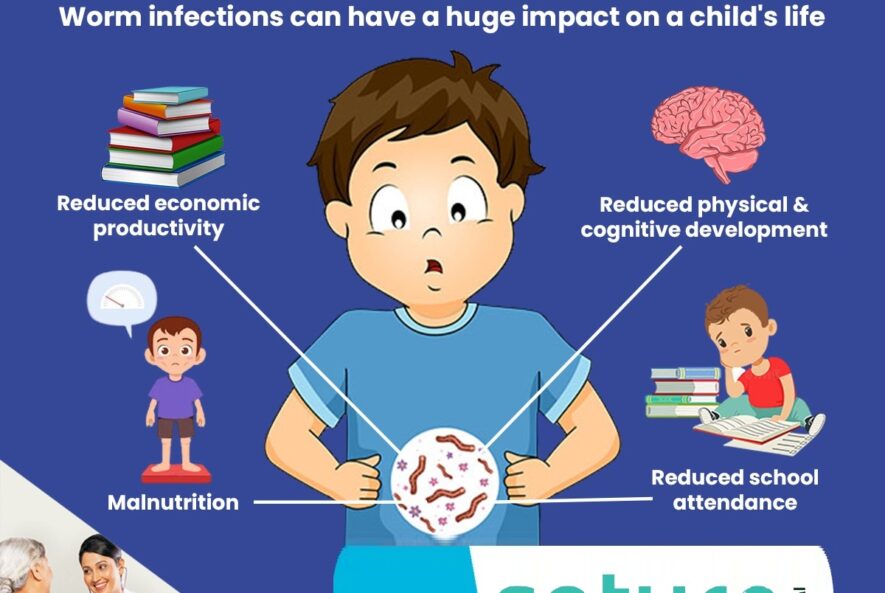
National Deworming Day operates under India’s National Health Mission, Ministry of Health and Family Welfare. It targets children and adolescents aged 1 to 19 years and is conducted on 10 February and 10 August each year. [1] The National Health Mission frames STH infections as a public health concern with consequences including interference with nutrient uptake and contribution to anaemia, malnourishment, and impaired mental and physical development. [1]
For R&D decision-makers, the relevance is specific. A low-cost, high-volume intervention of this type depends on three technical realities:
- Measurable efficacy in real-world settings.
- Repeatable delivery at high coverage.
- Data systems capable of tracking outcomes and guiding program adjustments.
These are operational constraints that apply to any novel product or regimen seeking programmatic adoption, not just to the drugs currently in use.
2. Global Burden and WHO Policy Framing
The World Health Organization estimates that STH infections affect populations with poor access to water, sanitation, and hygiene, and identifies children as among the most affected groups. [2] WHO’s 2017 guideline provides evidence-informed recommendations for preventive chemotherapy as a public health intervention in endemic areas, with the aim of reducing worm burden in at-risk groups including children and adolescents. [3]
That guideline does not substitute for national regulatory decisions, but it materially shapes how public health programs set eligibility, frequency, and monitoring expectations. For any new formulation, combination regimen, or product intended for programmatic use, the critical constraint is alignment to evidence standards that are acceptable to public health authorities and compatible with delivery at scale. [3]
3. The Evidence Base: What It Supports and What It Does Not
The published evidence on deworming outcomes is not uniform, and this matters for how programs are evaluated and how new products are justified.
A long-run follow-up study of a school-based deworming program in Kenya reported changes in adult outcomes, including labor supply among men and education among women, using community-level experimental variation. [4] A Cochrane review on public health deworming programs for children living in endemic areas, updated in 2019, assessed effects across outcomes such as nutritional indicators, haemoglobin, and school performance, and reports that average effects vary across settings and outcomes. [5]
The practical point for R&D and program strategy is narrow but firm: claims about impact must be tied to specific endpoints, populations, and study designs, and must not be generalized beyond what the underlying evidence supports. [4][5]
4. Current Treatments and the Drug Discovery Baseline
Preventive chemotherapy programs commonly use benzimidazoles, specifically albendazole and mebendazole. WHO’s 2017 guideline addresses preventive chemotherapy as a public health intervention for STHs in endemic areas. [3] A systematic review and meta-analysis published in JAMA assessed the efficacy of existing drugs against STH infections and provides comparative evidence across species and drugs in the trials it included. [6]
For a biotech or pharma portfolio, this creates a bounded innovation space. Any product advancement requires clear, measurable improvements over existing regimens in defined populations, or delivery innovations that materially improve real-world effectiveness under the constraints of mass programs. The WHO guideline is the baseline comparator for public health use. [3]
5. Drug Discovery and Target Identification: What the Genomics Literature Supports
Helminth genomics has expanded the knowledge base for parasite biology. A Nature Genetics paper reporting comparative genomics across 81 genomes of parasitic and non-parasitic worms describes gene family changes and expansions relevant to parasitism. [7] This supports a narrow, defensible statement for R&D leaders: genomic resources exist that can inform target discovery and comparative biology in helminths. [7]
No claims are made here about specific new targets, candidate molecules, or clinical breakthroughs beyond what is supported by the cited source.
6. Preclinical Development: Data Quality as the First Constraint
Mass programs are designed around population-level outcomes, but product development requires reproducible preclinical and clinical endpoints. The JAMA meta-analysis provides evidence that drug efficacy varies by parasite species and across trials, which is a practical reminder that assay choice, endpoint definition, and species-specific biology affect translational confidence. [6]
For R&D operations, this creates a data problem that precedes the biology problem. Three operational requirements follow:
- Consistent definitions of cure rate and intensity reduction across sites and cycles.
- Standardized data capture and quality controls that support reproducibility.
- Traceability of methods across sites and time to support regulatory and evidence submissions.
This is where data management and analytics become operational requirements rather than aspirational capabilities.
7. Manufacturing and Supply: Constraints That Can Be Stated Without Speculation
National Deworming Day is a fixed-date, high-volume delivery program conducted twice yearly across India. [1] This implies a narrow tolerance for disruptions in manufacturing or supply. From an industry standpoint, the problem is primarily one of reliability, packaging suitability for field distribution, and predictable availability timed to fixed campaign dates.
No specific cost levels, market sizes, or historical failure rates are stated here because those are not provided in the sources cited in this draft.
8. Technology, Data Operations, and Surveillance Quality
National-scale programs generate substantial operational and epidemiological data. The value of that data depends on standardization and reuse across cycles, which is a data management and analytics challenge. WHO’s preventive chemotherapy guideline and program documentation explicitly support the need for program-level evidence and monitoring in endemic settings. [3]
No claims are made about specific surveillance performance levels, digital platforms, or national coverage rates because those are not supported by the sources cited in this draft.
9. Saturo Global: Services Relevant to R&D, IP, and Scientific Data Work
Saturo Global describes its service offerings as including Data Curation Services, Indexing and Abstracting Services, Strategic Patent Support, and Data Visualization and Reporting. [8] Its service pages describe indexing and abstracting work on scientific literature and metadata, covering detailed indexing and concise abstracts. [9] The Strategic Patent Support page lists patent and literature search, portfolio analysis, landscaping studies, patent docketing services, and patent drafting support. [10] The Data Curation Services page describes transforming fragmented information into structured datasets, positioned for scientific and clinical data contexts. [11]
In a deworming-related R&D or portfolio context, these services map to practical needs that apply across disease areas:
- Data curation workflows supporting literature and evidence synthesis. [11]
- Indexing and abstracting supporting retrieval and review in research operations. [9]
- Patent searches, landscaping, and portfolio analysis supporting IP planning and freedom-to-operate screening. [10]
- Reporting and visualization for communicating evidence summaries to decision-makers. [8]
Conclusion
National Deworming Day is a fixed-day, population-scale intervention designed for children and adolescents, anchored in a public health approach to reducing soil-transmitted helminth burden in endemic settings. [1][3] The global burden remains large, and WHO continues to frame preventive chemotherapy as a key intervention in relevant contexts. [2][3] The evidence base contains findings that vary by setting and endpoint, and must be interpreted within the boundaries of the underlying studies and reviews. [4][5]
For biotech and pharma R&D leaders, the operational lesson is limited but durable: program-scale interventions impose constraints on evidence standards, data systems, delivery design, and supply reliability. Decisions about R&D investment and partnership strategy should be grounded in what can be measured and verified against public guidance and peer-reviewed evidence, rather than generalized assertions. [3][4][5][6]
References
[1] National Health Mission, Ministry of Health and Family Welfare, Government of India. Updated 25 February 2026. National Deworming Day. https://nhm.gov.in/index1.php?lang=1&level=3&lid=803&sublinkid=1454
[2] World Health Organization. 2023. Soil-transmitted helminth infections (Fact sheet). https://www.who.int/news-room/fact-sheets/detail/soil-transmitted-helminth-infections
[3] World Health Organization. 2017. Guideline: Preventive chemotherapy to control soil-transmitted helminth infections in at-risk population groups. Geneva: WHO. https://www.who.int/publications/i/item/9789241550116
[4] Baird S, Hicks JH, Kremer M, Miguel E. 2016. Worms at Work: Long-run Impacts of a Child Health Investment. The Quarterly Journal of Economics, 131(4), 1637-1680. https://doi.org/10.1093/qje/qjw022
[5] Taylor-Robinson DC et al. 2019. Public health deworming programmes for soil-transmitted helminths in children living in endemic areas. Cochrane Database of Systematic Reviews, 2019(9):CD000371. https://doi.org/10.1002/14651858.CD000371.pub7
[6] Keiser J, Utzinger J. 2008. Efficacy of current drugs against soil-transmitted helminth infections: systematic review and meta-analysis. JAMA, 299(16), 1937-1948. https://doi.org/10.1001/jama.299.16.1937
[7] International Helminth Genomes Consortium. 2019. Comparative genomics of the major parasitic worms. Nature Genetics, 51(1), 163-174. https://doi.org/10.1038/s41588-018-0262-1
[8] Saturo Global. Accessed February 2026. Saturo Global (Services overview). https://saturoglobal.com/
[9] Saturo Global. Accessed February 2026. Indexing and Abstracting Services. https://saturoglobal.com/services/indexing-abstracting-services/
[10] Saturo Global. Accessed February 2026. Strategic Patent Support. https://saturoglobal.com/services/strategic-patent-support/
[11] Saturo Global. Accessed February 2026. Data Curation Services. https://saturoglobal.com/services/data-curation-services/