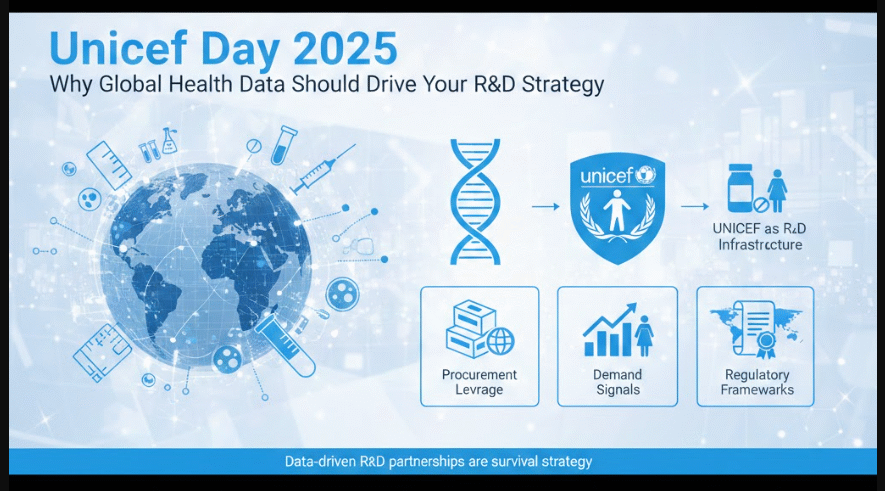
UNICEF Day 2025: Why Global Health Data Should Drive Your R&D Strategy
Contributed by: Nandu Prasad
The Market Failure Costing Lives
In 2023, UNICEF procured over 2.06 billion vaccine doses for 132 countries. Yet between 1980 and 2007, only 17 new obstetric drugs entered clinical evaluation, compared to 660 for cardiovascular diseases. The maternal mortality ratio stands at 197 deaths per 100,000 live births as of December 2023, with progress stalled since 2016 at just 1.5% annual reduction when we need 15% to meet 2030 targets.
712 women die daily from pregnancy complications. One maternal death every two minutes. Pharmaceutical companies invest $250+ billion annually in R&D, yet therapeutic areas with massive global burden remain chronically underfunded.
This is not advocacy. This is a structural market failure with quantifiable consequences, and UNICEF’s operational data documents it precisely.
UNICEF as R&D Infrastructure, Not Aid Organization
UNICEF maintains globally standardized datasets covering 197 countries across child mortality, maternal health, nutrition, immunization, and infectious disease. This infrastructure includes 150+ field offices with rigorous quality assurance protocols, annual updates, and internationally comparable statistical standards.
For R&D strategy, UNICEF represents three concrete assets:
Procurement leverage. As the world’s largest vaccine buyer, UNICEF’s operational constraints become manufacturing constraints for industry. Any biologic intended for last-mile distribution must demonstrate stability under UNICEF’s exact cold-chain specifications.
Demand signals. UNICEF analytics expand real-world datasets that refine disease mechanisms, validate biological pathways, and prioritize targets for paediatric and maternal health research. Under-five mortality dropped from 12 million deaths in 1990 to 4.8 million in 2023, yet pneumonia and diarrhoea treatment coverage remains at 30-33% in sub-Saharan Africa and South Asia.
Regulatory frameworks. Multiple patents explicitly reference WHO/UNICEF standards. UNICEF’s collaboration with WHO on immunization coverage reporting has created de-facto global standards for data quality and verification that directly impact regulatory pathways.
Drug Discovery: Finding Targets in Validated Burden Data
Pharmaceutical target selection should align with documented global disease burden. UNICEF data reveals specific opportunities:
Obstetric therapeutics. Maternal deaths from hemorrhage, eclampsia, and sepsis represent clear therapeutic targets with established market need. The Bill & Melinda Gates Foundation and others have committed resources to push mechanisms and advanced market commitments, successfully applied for malaria, AIDS, and tuberculosis. The same infrastructure exists for obstetric innovation.
Paediatric formulations. Under-five mortality data identifies pneumonia (15% of deaths) and diarrhoea (9% of deaths) as priorities. Oral rehydration solution coverage remains at 30% in highest-burden regions. Drug delivery innovations for paediatric populations represent quantifiable whitespace.
Neurodevelopmental targets. UNICEF’s Early Child Development Index (ECDI 2030) has been used in peer-reviewed research to detect cognitive-delay risk patterns, highlighting neurodevelopmental vulnerabilities in low-resource environments and environmental contributors to developmental delays worth investigating in drug discovery.
Automated diagnostics. Patents cite UNICEF extensively. One automated disease diagnosis patent (US11783947B2) notes that obtaining breathing rates in children remains “notoriously difficult,” with agencies like UNICEF and WHO committing resources to develop breathing rate counters. This signals clear demand for sensor-based paediatric tools that operate without continuous power or advanced infrastructure.
Preclinical Development: Designing for Real-World Constraints
UNICEF’s standardized indicator definitions enable cross-country comparisons impossible with fragmented national datasets. This matters for preclinical research in three ways:
Population-level endpoints. Standardized child anthropometry data (underweight, stunting, wasting) enables nutrition intervention trials with globally comparable endpoints. UNICEF data disaggregated by wealth quintile and urban/rural residence enables demonstration of equitable access plans.
Environmental stress testing. The WHO/UNICEF vaccine cold-chain standards (E5 IP) define design parameters for portable cold packs used during vaccine storage and transport. These standards influence stability studies for vaccines intended for low-resource environments, requirements for freeze-resistant carriers, and test conditions for biologics exposed to variable environmental stress.
Device specifications. UNICEF’s historic investment in breathing-rate measurement technologies signals demand for sensor-based paediatric tools that can operate without continuous power or advanced infrastructure. Preclinical teams designing devices, formulations, or biologics for global deployment must align with UNICEF’s technology-transfer frameworks from day one.
Regulatory Strategy: Leveraging UNICEF-Validated Evidence
UNICEF data directly informs regulatory strategy for products targeting maternal and child health:
Unmet medical need. Regulatory agencies require demonstration of unmet medical need. UNICEF datasets provide authoritative evidence. When maternal mortality progress stalled post-2016 despite earlier gains, this created regulatory rationale for new interventions.
Global standards integration. UNICEF’s governance role in monitoring child rights and health program performance directly impacts regulatory pathways. UNICEF’s policy support for interventions like Option B+ for HIV transmission prevention has influenced national regulatory adoption strategies. UNICEF’s oversight of child health and breastfeeding guidelines informs device labelling and maternal-health therapy standards.
Post-market surveillance infrastructure. UNICEF’s annual data compilation through field offices creates infrastructure for post-approval monitoring in resource-limited settings, addressing regulatory concerns about real-world effectiveness.
A freeze-free vaccine transport patent (US11285079B2) explicitly cites WHO/UNICEF E5 IP standards for portable cold pack size, shape, and volume. A bassinet patent (US12285973B2) references WHO/UNICEF’s Ten Steps for Successful Breastfeeding as established global evidence-based best practices. Using UNICEF-aligned metrics in preclinical work streamlines regulatory pathways.
Manufacturing and Scale-Up: Building to UNICEF Specifications
UNICEF is one of the world’s largest purchasers of vaccines and essential medical equipment. This scale means its operational constraints become manufacturing constraints for industry.
Cold-chain requirements. UNICEF defines technical specifications for cold-chain carriers. Any biologic intended for last-mile distribution must demonstrate stability under those exact specifications. Patents document this explicitly: the freeze-free transport carrier patent notes WHO and UNICEF provide standards for portable cold packs used with vaccine storage, defining specific dimensions and performance requirements.
Sensor and diagnostic devices. UNICEF-supported initiatives in automated respiratory diagnostics underscore the need for devices that function accurately without specialized calibration infrastructure. Manufacturing teams designing for global health markets must build products that survive the constraints documented by UNICEF’s field requirements.
Maternal and neonatal equipment. Breastfeeding support frameworks continue to influence neonatal-care device designs, as shown in recent patent disclosures referencing these standards.
For biologics and cell therapies targeting global markets, UNICEF cold-chain specifications are not optional. They are the standard. Companies designing manufacturing scale-up for maternal-child products must engineer to these specifications from the start.
Data Analytics and AI: Closing the Intelligence Loop
UNICEF’s Digital Health Centre of Excellence coordinates COVID-19 vaccine deployment, real-time immunization monitoring, and supply chain digitalization. The 2024 Digital Health report highlights primary health care capacity building, geographic information systems, and remote health worker training across 68 countries.
This creates specific opportunities for pharmaceutical data services:
Predictive modelling. Maternal mortality trend data (2000-2023) enables AI models to predict regional hotspots requiring intervention. WHO/UNICEF estimation methods offer transparent logic for resolving conflicts between administrative reports and survey data, which can inspire robust analytic pipelines for safety surveillance and coverage modelling.
Clinical trial site selection. Field office data on health infrastructure, skilled birth attendance rates, and facility capabilities informs site feasibility assessment for maternal-child health trials. AI models trained on UNICEF-aligned coverage and systems indicators can forecast bottlenecks in uptake.
Supply chain optimization. UNICEF’s geospatial health solutions identify high-risk areas. Pharmaceutical supply chains can integrate this data for targeted distribution. Analytics that anchor to UNICEF-recognized indicators help portfolio governance justify paediatric prioritization.
For AI-driven drug discovery, trial optimization, and real-world evidence generation, UNICEF datasets offer large-scale, longitudinal paediatric health data, cross-country comparative indicators, and population-level insights for machine-learning models. AI gains strategic value when grounded in high-quality, internationally validated data.
Technology Transfer: Building Local Manufacturing Capacity
UNICEF’s work through platforms like RapidPro and the HealthConnekt initiative (targeting every health worker worldwide by 2030) creates infrastructure for technology transfer partnerships. For pharmaceutical companies pursuing global market strategies, UNICEF data identifies:
- Countries with growing immunization coverage (potential vaccine manufacturing partners)
- Regions with digital health infrastructure (enabling remote monitoring for complex therapies)
- Markets with government commitment to maternal-child health (regulatory fast-track potential)
The partnership between Health Effects Institute and UNICEF, showing air pollution as second leading risk factor for under-five deaths, demonstrates how data partnerships drive public health priorities and R&D funding allocation.
Strategic Imperatives for 2026 Planning
Organizations that integrate UNICEF-driven insights into their R&D pipelines will be positioned to lead in paediatric, maternal, and global health markets. The question for 2026 planning is not whether UNICEF’s mission aligns with life sciences R&D priorities. It already does. The question is execution.
R&D leaders should:
- Define paediatric target product profiles against WHO/UNICEF coverage baselines for target countries
- Stress-test delivery requirements against documented workforce and logistics capacity
- Build CMC with cold-chain and transport constraints from day one
- Pre-wire regulatory narratives with implementation feasibility evidence accepted by programs
- Align analytics to WHO/UNICEF estimation logic to ensure comparability
Progress on maternal mortality has stalled. Pneumonia and diarrhoea treatment coverage remains at 30% in highest-burden regions. 14 million infants lack vaccinations. These are not statistics. They are market signals.
Companies that integrate UNICEF data into discovery target selection, preclinical model development, regulatory strategy, and manufacturing specifications will identify opportunities competitors miss. The ones that continue developing cardiovascular drugs while obstetric medicine stagnates will face strategic obsolescence.
Innovation only matters if it survives real-world conditions. UNICEF Day is an annual reminder that the global paediatric health ecosystem still depends on next-generation tools that are scientifically rigorous, clinically adaptable, and manufacturable at scale.
Data-driven R&D partnerships are survival strategy.
How Saturo Global Accelerates UNICEF-Connected R&D
Data Curation and Management. Saturo Global harmonizes fragmented datasets including epidemiological, clinical, demographic, and supply-chain data to produce unified, analysis-ready datasets aligned with UNICEF’s global health indicators. For maternal health drug programs, this means integrating UNICEF’s maternal mortality estimates, WHO skilled birth attendance data, and regional hospital capacity metrics into single analytical workflows.
Indexing and Abstracting. Saturo Global transforms worldwide research articles and patent filings into structured, searchable intelligence. This includes UNICEF-linked patents on diagnostics, cold-chain systems, and maternal-health tools. The patent landscape referencing UNICEF standards spans automated diagnostics, vaccine transport, and medical devices. When a breathing rate counter patent cites UNICEF’s commitment to this technology, that signals adjacent innovation opportunities.
Strategic Patent Support. Saturo Global’s patent landscapes allow R&D organizations to track emerging innovations connected to UNICEF-supported areas, track technology transfer opportunities, and map whitespace where UNICEF data reveals unmet needs without corresponding IP activity. UNICEF data provides regulatory justification for patent claims.
Data Visualization. UNICEF publishes trend data, but translating 197-country datasets into strategic insights requires specialized analytics. Saturo Global transforms UNICEF’s statistical tables into executive dashboards showing maternal mortality hotspots correlated with market opportunity, immunization gap analysis mapped to vaccine pipeline priorities, and paediatric disease burden overlaid with competitive landscape analysis.
R&D teams gain operational advantage by aligning product strategy with globally validated health needs.
References
[1] Abeyratne U. Method and apparatus for automatic disease state diagnosis. US11783947B2. 2023.
[2] Naccarella L et al. Transforming UNICEF’s approach to health system strengthening. Hum Resour Health. 2021. doi:10.1186/s12960-021-00553-8
[3] Chou FL. Freeze-free medicinal transport carriers. US11285079B2. 2022.
[4] Murray C, Newby H. Data resource profile: UNICEF. Int J Epidemiol. 2012. doi:10.1093/ije/dys185
[5] van der Eijk Y et al. The tobacco industry and children’s rights. Paediatrics. 2018. doi:10.1542/peds.2017-4106
[6] Burton A et al. WHO and UNICEF estimates of national infant immunization coverage. Bull WHO. 2009. doi:10.2471/blt.08.053819
[7] Hromi-Fiedler AJ et al. Assessing UNICEF’s C-IYCF CP. Curr Dev Nutr. 2022. doi:10.1093/cdn/nzac018
[8] Onambele L et al. Maternal Mortality in Africa. Int J Environ Res Public Health. 2022. doi:10.3390/ijerph192013146
[9] Forsyth S. Global infant feeding policies and UNCRC. Ann Nutr Metab. 2025. doi:10.1159/000546054
[10] Emerson E, Llewellyn G. ECDI 2030 and cognitive delay. J Intellect Disabil Res. 2025. doi:10.1111/jir.13245
[11] Buhimschi CS. Methods for detecting misfolded proteins. AU2022291625B2. 2024.
[12] Aryeetey R et al. Breastfeeding policy networks in Ghana. Int Breastfeed J. 2020. doi:10.1186/s13006-020-00311-x
[13] Chersich MF et al. UNICEF’s role in Option B+. Global Health. 2018. doi:10.1186/s12992-018-0369-2
[14] Tully KP. Bassinet. US12285973B2. 2025.
[15] UNFPA. Trends in Maternal Mortality 2000-2023. 2025.
[16] UNICEF DATA. Maternal Mortality Rates and Statistics. 2025.
[17] Fisk N, Atun R. Drug Development for Maternal Health Cannot Be Left to the Whims of the Market. PLOS Medicine. 2008. doi:10.1371/journal.pmed.0050140
[18] UNICEF. Levels & Trends in Child Mortality 2024. 2024.
[19] UNICEF. Pneumonia and Diarrhoea: Tackling the Deadliest Diseases. 2012. doi:10.1016/S0140-6736(12)60907-6
[20] WHO & UNICEF. WHO/UNICEF Estimates of National Immunization Coverage. 2025.
[21] UNICEF. Digital Health and Information Systems 2024 Annual Report. 2024.
[22] IQVIA Institute. Global Trends in R&D 2025. 2025.